












How AI Has Changed What Work Requires
AI isn’t just a new tool—it has rewritten what it means to be employable. The rules of work have shifted, and they are reshaping how we are hired, trained, evaluated, and valued. This isn’t a minor update. It’s a cultural reset.
🔁 1. Skills That Once Took Years Are Now Baselines
Tasks that once required degrees, apprenticeships, or long-term mastery—like data analysis, design drafts, coding support, or research—can now be accelerated by AI tools in seconds.
But here’s something many younger workers may not realize:
Older generations have lived through this shift before.
Some of us mastered tools that felt like the pinnacle of innovation:
- typewriters and correction tape
- shorthand note-taking systems
- card catalogs in libraries
- microfiche machines
- DOS command lines
- landline switchboards
- fax machines
- pagers
- carbon-copy forms
- overhead projectors
- floppy disks and dial-up modems
- early spreadsheets like Lotus 1-2-3
- film-based cameras and darkrooms
We learned them. Used them. Excelled at them.
Then one by one, they vanished.
The painful lesson?
Your value decreases when your speed, tools, and methods no longer match the environment around you.
If you couldn’t transition from typewriter to computer, from card catalog to database, from DOS to Windows—
your career options shrank.
Today’s version of that transition is simple:
If you refuse to learn AI, you’re choosing to be slower in a world that rewards faster.
And slower workers get passed over, priced out, or quietly replaced.
🧠 2. AI Is the First Technology That Automates the Mind
Machines have always replaced physical labor.
AI replaces mental labor.
It can:
- write first drafts
- analyze huge data sets
- summarize complex documents
- generate code
- create images or prototypes
- brainstorm solutions
This shifts human value from:
❌ memorizing information
❌ repeating steps
❌ doing predictable tasks
to:
✔ interpreting meaning
✔ asking better questions
✔ applying judgment
✔ connecting ideas others can’t see
We are no longer paid for what we know.
We are paid for what we can do with what we know.
🚀 3. Productivity Expectations Have Accelerated
The standard of “a good day’s work” has changed forever.
What was once a full day’s output can now be done before lunch.
That raises the bar:
- project timelines shrink
- performance expectations rise
- teams get smaller
- cross-role competence becomes normal
AI didn’t eliminate work.
It compressed it.
Those who thrive are those who let AI carry the weight that once exhausted them.
🎯 4. Expertise Has Been Redefined
Expertise used to be measured by how much information you could store.
Now expertise is measured by:
- your clarity of thought
- your ability to filter noise
- your discernment
- your capacity to apply knowledge in context
- your ability to ask the right questions
The expert of the AI era is not the walking encyclopedia.
It’s the person who can:
turn abundance into insight.
🛠️ 5. Every Worker Is Now a Systems Designer
Automation is no longer someone else’s job.
Today’s worker is expected to:
- build workflows
- design prompts
- integrate tools
- delegate tasks to machines
- improve systems instead of simply using them
Even without a tech title, every role is tilting toward engineering thinking.
🎧 6. Soft Skills Have Become Hard Power
Once undervalued, human abilities are now the scarce resource:
- empathy
- intuition
- cultural awareness
- emotional intelligence
- conflict navigation
- ethical reasoning
- storytelling
- leadership
As AI does more of the thinking, humans who can feel, discern, and connect become irreplaceable.
Those who can be understood—and help others feel understood—will always have work.
🔮 The Core Requirement of This Era
The old workplace rewarded those who learned a skill and held onto it for decades.
The new workplace rewards those who evolve.
Not the smartest.
Not the youngest.
Not the fastest.
The most adaptable.
The people who remember:
It is not the innovation that threatens you—
it is refusing to grow alongside it.
🌱 In Summary
AI transformed work by shifting value from:
tasks → thinking
knowledge → discernment
speed → adaptability
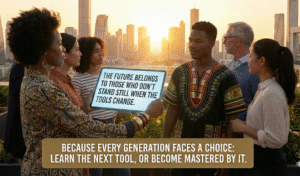
The future belongs to those who don’t stand still when the tools change.
Because every generation faces a choice:
learn the next tool,
or become mastered by it.
To be sure, there will be guidelines, laws, boundaries, and legislation put in place. That has been the case with every innovation. None has ever arrived without resistance. None has ever unfolded without struggle. And every single time, advocates have had to push to make sure that the most burdened communities—minoritized groups, poor families, and those living far from centers of power—do not continue to carry the weight of society’s progress while others reap the benefits.
The technology may be new.
But the responsibility remains ancient:
Innovation must never advance faster than justice.
AI isn’t just a new tool—it has rewritten what it means to be employable. The rules of work have shifted, and they are reshaping how we are hired, trained, evaluated, and valued. This isn’t a minor update. It’s a cultural reset.
🔁 1. Skills That Once Took Years Are Now Baselines
Tasks that once required degrees, apprenticeships, or long-term mastery—like data analysis, design drafts, coding support, or research—can now be accelerated by AI tools in seconds.
But here’s something many younger workers may not realize:
Older generations have lived through this shift before.
Some of us mastered tools that felt like the pinnacle of innovation:
- typewriters and correction tape
- shorthand note-taking systems
- card catalogs in libraries
- microfiche machines
- DOS command lines
- landline switchboards
- fax machines
- pagers
- carbon-copy forms
- overhead projectors
- floppy disks and dial-up modems
- early spreadsheets like Lotus 1-2-3
- film-based cameras and darkrooms
We learned them. Used them. Excelled at them.
Then one by one, they vanished.
The painful lesson?
Your value decreases when your speed, tools, and methods no longer match the environment around you.
If you couldn’t transition from typewriter to computer, from card catalog to database, from DOS to Windows—
your career options shrank.
Today’s version of that transition is simple:
If you refuse to learn AI, you’re choosing to be slower in a world that rewards faster.
And slower workers get passed over, priced out, or quietly replaced.
🧠 2. AI Is the First Technology That Automates the Mind
Machines have always replaced physical labor.
AI replaces mental labor.
It can:
- write first drafts
- analyze huge data sets
- summarize complex documents
- generate code
- create images or prototypes
- brainstorm solutions
This shifts human value from:
❌ memorizing information
❌ repeating steps
❌ doing predictable tasks
to:
✔ interpreting meaning
✔ asking better questions
✔ applying judgment
✔ connecting ideas others can’t see
We are no longer paid for what we know.
We are paid for what we can do with what we know.
🚀 3. Productivity Expectations Have Accelerated
The standard of “a good day’s work” has changed forever.
What was once a full day’s output can now be done before lunch.
That raises the bar:
- project timelines shrink
- performance expectations rise
- teams get smaller
- cross-role competence becomes normal
AI didn’t eliminate work.
It compressed it.
Those who thrive are those who let AI carry the weight that once exhausted them.
🎯 4. Expertise Has Been Redefined
Expertise used to be measured by how much information you could store.
Now expertise is measured by:
- your clarity of thought
- your ability to filter noise
- your discernment
- your capacity to apply knowledge in context
- your ability to ask the right questions
The expert of the AI era is not the walking encyclopedia.
It’s the person who can:
turn abundance into insight.
🛠️ 5. Every Worker Is Now a Systems Designer
Automation is no longer someone else’s job.
Today’s worker is expected to:
- build workflows
- design prompts
- integrate tools
- delegate tasks to machines
- improve systems instead of simply using them
Even without a tech title, every role is tilting toward engineering thinking.
🎧 6. Soft Skills Have Become Hard Power
Once undervalued, human abilities are now the scarce resource:
- empathy
- intuition
- cultural awareness
- emotional intelligence
- conflict navigation
- ethical reasoning
- storytelling
- leadership
As AI does more of the thinking, humans who can feel, discern, and connect become irreplaceable.
Those who can be understood—and help others feel understood—will always have work.
🔮 The Core Requirement of This Era
The old workplace rewarded those who learned a skill and held onto it for decades.
The new workplace rewards those who evolve.
Not the smartest.
Not the youngest.
Not the fastest.
The most adaptable.
The people who remember:
It is not the innovation that threatens you—
it is refusing to grow alongside it.
🌱 In Summary
AI transformed work by shifting value from:
tasks → thinking
knowledge → discernment
speed → adaptability
The future belongs to those who don’t stand still when the tools change.
Because every generation faces a choice:
learn the next tool,
or become mastered by it.
To be sure, there will be guidelines, laws, boundaries, and legislation put in place. That has been the case with every innovation. None has ever arrived without resistance. None has ever unfolded without struggle. And every single time, advocates have had to push to make sure that the most burdened communities—minoritized groups, poor families, and those living far from centers of power—do not continue to carry the weight of society’s progress while others reap the benefits.
The technology may be new.
But the responsibility remains ancient:
Innovation must never advance faster than justice.