











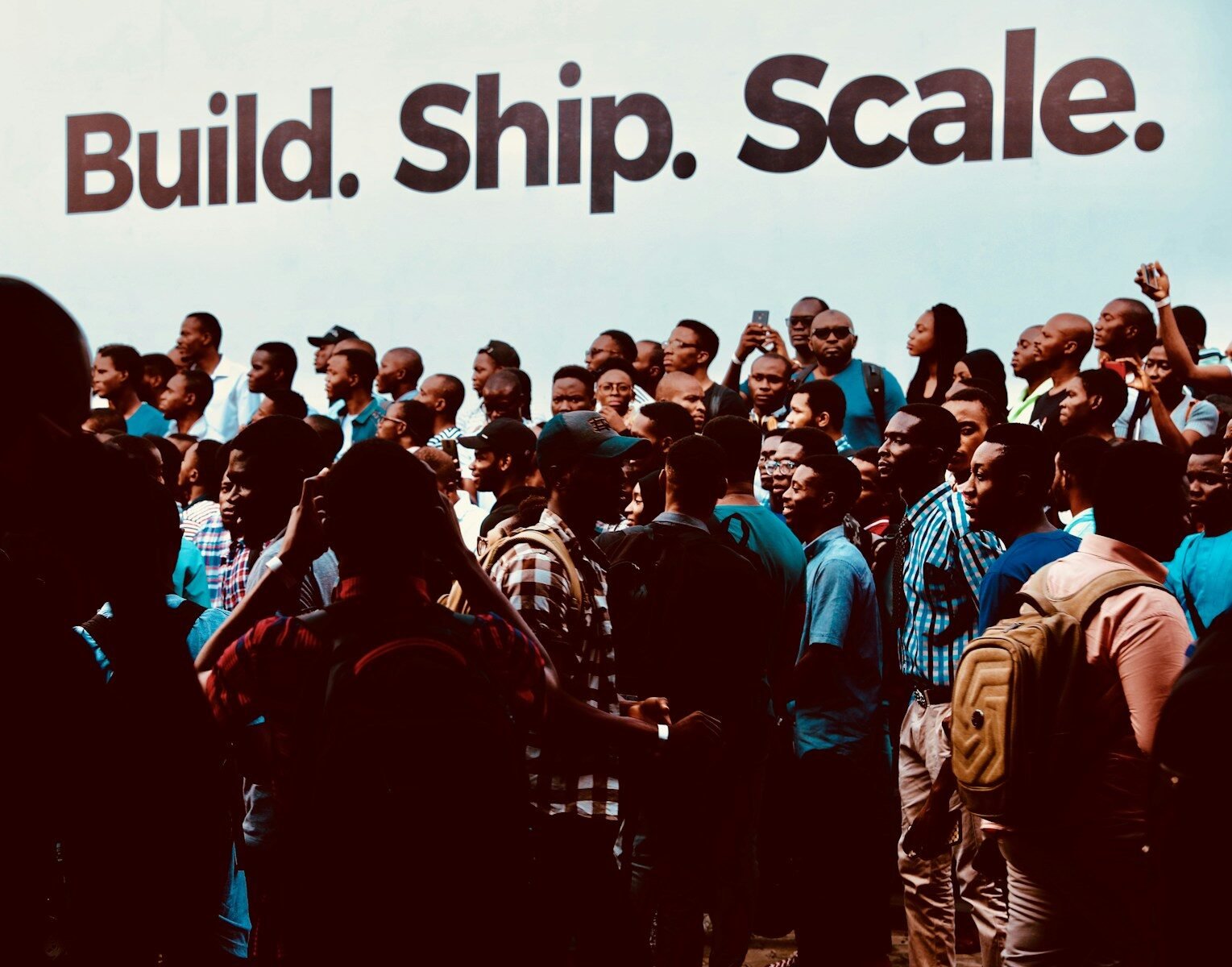
Competition Is Global Now. Refusing Technology Will Not Stop the World From Hiring Someone Else.
There is a dangerous comfort in believing that if our household, our school, our workplace, our church, our community, or our country decides not to accept a technology, then the world will slow down with us.
It will not.
That is not said with cruelty. It is said with care.
Because the competition is no longer only the person down the street, the business across town, or the student in the next district. Competition is global now.
The person applying for the same contract may be in another state.
The designer bidding on the same project may be in another country.
The researcher, tutor, editor, assistant, coder, marketer, translator, analyst, or consultant may be working from a place many people in the United States barely mention when they talk about technology.
And while some adults are still name-calling AI, students and workers around the world are learning it.
China is not waiting.
India is not waiting.
Rwanda is not waiting.
Kenya is not waiting.
Nigeria is not waiting.
South Africa is not waiting.
And those are only a few examples.
This is the part too many people miss. Refusing technology in one part of the world does not mean other people will refuse it too. It does not mean other children will be held back. It does not mean other workers will stop preparing. It does not mean employers will ignore skilled people elsewhere who can deliver faster, cheaper, smarter, or with better technological fluency.
Someone else is learning.
Someone else is practicing.
Someone else is building.
Someone else is becoming easier to hire.
The World Is Already Teaching Its Young People AI
China has moved aggressively toward AI education. Its Ministry of Education has issued guidance on strengthening AI literacy in primary and secondary schools, and China has announced plans for a tiered AI education system across primary, junior high, and senior high levels. The goal is not simply to let children play with tools. The goal is to build a structured pipeline of AI literacy and technological readiness.
China has also announced a broader action plan to build an AI literacy system across schooling and lifelong learning. That matters. They are not treating AI as a passing classroom toy. They are treating it as national capacity.
India has also been moving AI into schools for years. India’s Central Board of Secondary Education introduced Artificial Intelligence as an optional subject for Class IX starting in the 2019-2020 school year, with an AI “Inspire module” for Class VIII. Newer CBSE materials for 2026-27 cover Computational Thinking and Artificial Intelligence for Classes 3-8, including younger students.
That means children in some places are not waiting until college to learn these systems. They are being introduced to computational thinking, AI concepts, and digital problem-solving much earlier.
And Africa should never be left out of this conversation.
Rwanda, for example, has launched a national AI learning initiative with ALX, Anthropic, and the Government of Rwanda. The stated ambition is to place safe AI in the hands of educators so students can gain timely, future-ready skills.
Rwanda has also worked with Day of AI and MIT RAISE, in collaboration with the Rwanda Ministry of Education and Rwanda Education Board, on a national initiative to bring AI literacy into classrooms by preparing educators.
Kenya is also moving. A 2025 Raspberry Pi Foundation report described AI education work with Kenyan teachers, noting that more than 100 teachers from over 80 schools across 37 counties participated in training. That matters because teacher readiness often determines whether students get thoughtful AI literacy or shallow tool exposure.
Nigeria is not sitting still either. In Edo State, Nigeria, a World Bank-supported pilot used generative AI in an after-school learning program. Students worked with AI tools under teacher supervision, with prompts designed to support reasoning rather than shortcuts.
South Africa has been developing Coding and Robotics curricula for Grades R-9, with the Department of Basic Education describing this work as preparation for emerging technologies, including the Internet of Things, Robotics, and Artificial Intelligence.
UNESCO has also been clear that AI literacy is becoming an education priority, with frameworks being developed for both students and teachers.
So no, this is not just a Silicon Valley story.
It is not only a United States story.
It is not only a Europe story.
It is global.
And when Americans talk as though only “our children” are dealing with AI, we are already behind in the conversation.
Name-Calling Is Not a Workforce Plan
People can call AI whatever they want.
They can call it lazy.
They can call it fake.
They can call it cheating.
They can call it dangerous.
They can call it soulless.
They can call it a fad.
Some of those concerns deserve serious discussion. AI can be misused. AI can flatten creativity. AI can produce false information. AI can violate privacy. AI can reproduce bias. AI can be used to exploit labor. AI can be used by powerful people to cut corners and shift costs onto workers.
But name-calling alone is not strategy.
Mockery does not build skill.
Suspicion does not build a portfolio.
Fear does not prepare a child for the future.
Refusal does not stop the hiring market.
And history has already shown us what often happens next. True stories.
The same people who once mocked email eventually needed an email address.
The same people who resisted smartphones eventually needed apps for banking, directions, work, school, health care, tickets, appointments, and communication.
The same people who said the internet was not real life eventually needed websites, search engines, online applications, and digital forms.
The same thing will happen with AI.
Some of the loudest critics will quietly adapt when they have to.
They may not announce it.
They may not apologize.
They may not say, “I was wrong.”
They will simply begin using the tools when the pressure becomes unavoidable.
That is how history often works.
First comes dismissal.
Then comes resistance.
Then comes quiet adoption.
Then comes dependence.
The wiser path is not panic and not worship.
The wiser path is early, values-based readiness.
The Global Marketplace Does Not Care That We Are Uncomfortable
A business that needs a graphic designer can hire someone locally, or it can hire someone online from nearly anywhere. The decision will be both budget and need-based.
A publisher that needs editing can hire someone nearby, or it can hire someone across the world.
A company that needs customer service can build a distributed team.
A nonprofit that needs research help can work with a trained person overseas.
A parent looking for tutoring can hire someone from another country.
A client who needs a website, training manual, podcast edit, lesson plan, spreadsheet, translation, content calendar, app prototype, or marketing campaign can choose the best person who can deliver.
That person may be local.
They may not be.
This is the truth: being talented is not always enough anymore.
Talent matters.
Integrity matters.
Human judgment matters.
Cultural understanding matters.
But talent without modern tools can get boxed in.
A skilled educator who refuses online teaching tools may lose opportunities to someone who can teach in person and online.
A small business owner who refuses digital payments may lose customers who no longer carry cash.
A consultant who refuses AI literacy may lose contracts to someone who can produce faster research summaries, cleaner proposals, stronger training materials, and better client workflows.
A student who refuses to learn modern tools may discover that the job market does not reward refusal.
It rewards readiness.
That may feel harsh.
But it is better to confront it now than be surprised later.
This Is Not About Becoming a Machine
Learning AI does not mean surrendering your values.
It does not mean letting technology raise children.
It does not mean trusting every platform.
It does not mean handing private data to corporations without thought.
It does not mean replacing books, elders, teachers, lived experience, faith, cultural wisdom, or human conversation.
It means understanding the world as it is becoming.
It means knowing enough to choose wisely.
It means being able to say:
“I know what this tool does.”
“I know what it does not do.”
“I know when it is useful.”
“I know when it is dangerous.”
“I know how to check its work.”
“I know how to protect private information.”
“I know how to teach a child not to mistake a polished answer for truth.”
“I know how to compete without losing myself.”
That is not surrender.
That is adult preparedness.
Communities That Have Been Left Out Before Should Not Be Last Again
The people most often told to “catch up” are usually the same people who were denied access in the first place.
Denied good schools.
Denied capital.
Denied broadband.
Denied professional networks.
Denied safe work.
Denied ownership.
Denied credit for innovation.
Denied protection when systems changed.
So we need to be careful when people say, “Don’t worry about AI.”
Who gets to be relaxed?
Who already has the money, staff, tutors, lawyers, consultants, and networks to adapt later?
Who gets to resist publicly while quietly preparing privately?
Who gets to call technology evil while their children attend schools where AI literacy is already being taught?
That is the question.
Because some people can afford to be late.
Many others cannot.
For Black communities, rural communities, working-class communities, immigrant communities, disabled people, elders, and small independent creators, technological readiness is not about chasing trends.
It is about not being locked out again.
It is about not waiting until the new gate is already built and guarded.
It is about learning early enough to ask better questions, protect our children, build our own systems, and keep ownership where we can.
How to Stay Ahead and Keep Your Values
1. Learn the basics before forming your final opinion
You do not have to love AI to understand it.
Learn the basic language:
AI.
Automation.
Prompt.
Chatbot.
Large language model.
Training data.
Bias.
Privacy.
Hallucination.
Digital workflow.
Verification.
If you do not know the language, people can make decisions over your head.
Words are not everything, but they open doors.
2. Watch what other countries are teaching
Do not only look at local schools.
Look globally.
Ask:
What are students in China learning?
What is India putting into school curriculum?
What is Rwanda doing with teacher AI training?
What is Kenya doing with AI literacy?
What is Nigeria testing in classrooms?
What is South Africa building through coding and robotics?
What is UNESCO recommending?
This does not mean copying every country.
It means refusing to be provincial in a global economy.
3. Teach children discernment, not dependence
Children should not be taught to treat AI like a magical answer machine.
They should learn to ask:
“Could this be wrong?”
“What is missing?”
“Who created this tool?”
“What information should I not share?”
“Does this answer include people like me?”
“Should I check another source?”
“Do I still understand the assignment?”
AI literacy is not just tool use.
It is judgment.
4. Build a simple weekly learning practice
Do not try to learn everything at once.
Pick one tool.
Use it for one practical task.
Ask it to summarize something.
Ask it to compare options.
Ask it to help organize notes.
Ask it to create a checklist.
Ask it to explain a concept at three reading levels.
Then check the work.
The checking is where your mind stays strong.
5. Use AI to strengthen your work, not replace your thinking
Weak use of AI says:
“Do this so I do not have to think.”
Stronger use says:
“Help me see the gaps.”
“Help me compare these options.”
“Help me make this clearer.”
“Help me organize my research.”
“Help me create a first draft I can improve.”
“Help me turn this into a system.”
Use the tool as a helper.
Not as your brain.
6. Protect privacy as a life skill
Privacy is not paranoia.
Privacy is literacy.
Do not put sensitive personal, family, student, client, medical, financial, legal, or workplace information into tools without understanding the risk.
Teach children the same.
A child should not put their full name, school, address, private family matters, photos, secrets, or identifying details into AI tools.
Convenience should never outrank safety.
7. Create proof of skill
In a global marketplace, people need to see what you can do.
Build a simple portfolio.
Save samples.
Create case studies.
Show before-and-after improvements.
Make a small website.
Keep examples of your writing, designs, research, lesson plans, trainings, spreadsheets, videos, or project workflows.
Do not wait for someone to guess that you are capable.
Make your competence visible.
8. Keep human skills sharp
AI can generate words, images, plans, outlines, and summaries.
But human depth still matters.
Keep building:
Judgment.
Listening.
Leadership.
Ethics.
Writing.
Speaking.
Teaching.
Cultural knowledge.
Taste.
Pattern recognition.
Relationship-building.
Original thought.
Courage.
The more generated content floods the world, the more valuable real human discernment becomes.
9. Ask who benefits
Every new technology carries power.
Ask:
Who owns it?
Who profits?
Who is being watched?
Who is being replaced?
Who is being trained on?
Who is being left out?
Whose language is centered?
Whose culture is flattened?
Who pays for the infrastructure?
Who gets hired because of it?
Who gets dismissed because they never learned it?
These are not anti-technology questions.
They are responsible questions.
10. Adapt without surrendering
You can learn AI and still love books.
You can use AI and still honor elders.
You can teach children technology and still protect childhood.
You can build digital skills and still value handwriting, storytelling, craft, prayer, community, memory, and face-to-face care.
The goal is not to become a machine.
The goal is to become harder to exclude.
The Hard Landing
The world will not wait for our comfort.
Other countries are training.
Other students are practicing.
Other workers are adapting.
Other businesses are building.
Other communities are preparing.
And when the hiring decision comes, many employers will not care who had the purest opinion about technology.
They will care who can do the work.
Who can learn.
Who can adapt.
Who can communicate.
Who can protect data.
Who can use modern tools wisely.
Who can produce.
Who can think.
Who can verify.
Who can solve problems.
That is the competition now.
Global.
Fast-moving.
Uneven.
Sometimes unfair.
But real.
Refusing to learn does not protect tradition.
Refusing to learn does not protect children.
Refusing to learn does not protect workers.
Refusing to learn does not protect communities.
What protects us is wisdom with tools in its hands.
Values with skill behind them.
Curiosity with boundaries.
Criticism with competence.
And preparation before panic.
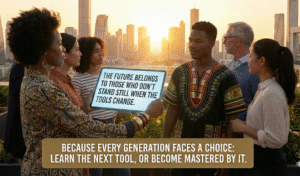
Because the future will not ask whether we approved of change before it arrived.
It will ask whether we were ready.